18th November - Decide on candidates for focus group - Leah
18th November - Decide on questions that we will ask our target audience - Emma
20th November - Send a survey to our candidates via 'Facebook' requesting responses to moodboard, opinion on similar music videos from our genre and their synaesthetic imagery in response to our song - Emma and Leah
22nd November - Write up audience response on blog and assess whether plans need changing. Also judge whether aspects of our video need changing following the audience response - Emma and Leah
For our music video we intend to tell a fairly conventional love story of two people going through a hard time in a relationship, but with a bit of a twist. We intend to make these two people mime artists, to create an alternative tale to the conventions portrayed in mainstream media, whilst making it comply to the indie genre by being 'different'. Our initial inspiration for this idea came from the film 'Paris Je T'aime' which is a French film featuring a variety love stories in Paris. One of the stories told is about two mime artists and the clip is embedded below.
Definition and history A 'mime artist' is someone who uses mime as a theatrical medium and uses mime and body motion instead of speech. Mime is established through silent comedy, and in the nineteenth century in Paris, Jean-Gaspard Deburauestablished the mime character that is well known in modern society: the white faced mime.The twentieth century bought motion picture, a new medium for mime artists. Due to the lack of technology in the early twentieth century, minimal speech could be used in filming therefore mime became a popular platform. Charlie Chaplin became a famous silent film comedian, and became one of the most documented mimes in history.
Although this clip is not the exact mime character we are aiming to establish in our music video, the old film style and general mise-en-scene is similar, as well as other features such as the actors over-dramatic facical expression and bodily language to demonstrate emotion. This clip is in monochrome due to the early period in which is was filmed, and also there are very basic shots used, ranging mostly between two-shots and mid shots. These are kept constant in order to keep the portrayal of the actors emotion simple and understandable for the reader, as in the time this was filmed post production effects and camera techniques utilised in modern technology weren't really established. We aim to replicate this era in our music video to give it an individual and interesting feel, whilst contradicting the polished and perfect look portreyed in mainstream music videos. This old fashioned film style occured in early film from around the 1910's onwards. These films were influencial towards other media platforms in the future, and therefore in the 1940's, the 'Soundies' were born.
The Soundies The soundies were an early version of music video, which were produced in places such as Hollywood, New York and Chicago in the 1940's. They were played on jukeboxes called panorams or scopitones and played in bars, pubs and clubs. Soundies covered all types of music, from big band swing to patriotic songs. Popular artists of that time such as Doris Day, Lawrence Welk, Gale Storm, Kay Starr and many more made Soundies.
This film style again features the monochrome film grain look which we are aiming to achieve in our music video. Also similarly to the Charlie Chaplin clip, this video features fairly basic shots, made up of mostly mid shots and wide shots to show the dancers clearly. As opposed to the average music video nowadays which will usually feature around 250 shots whereas this particular video only features around 20. This is due to the technology at the time, as they would not have had the facilities to create fast paced and effective continuity editing like in modern videos. In our music video we are going to take inspiration from these clips in the sense of creating an old fashioned film look, however we are going to feature a more varied range of shots to keep it modern and interesting. We feel that these influences in our video will help the video correspond with the indie genre and appeal to the demographic of our target audience as it would oppose the polished images portrayed in mainstream modern videos.
This was the power point presentation for our Music Video pitch.
The majority of the feedback from our music video pitch was positive, people particularly liked the stop motion test shoot and the mime idea as the focal point. We received comments such as: "Use of stop motion - this adds another dimension to the video. Mime characters are certainly original." "Using mimes to tell the story is very unique" "Puts a twist on the indie conventions"
Some concerns that our audience had were regarding the choice of our target audience demographic, stating that the range of our target audience profile was too large. On our pitch we stated that the target audience would be between A and C2 on the Jicnars scale, but as our target audience were mostly students the placement of our audience on the Jicnars scale would be based around their parents income. We did a survey of our class and we discovered that students who had parents with a higher income were equally as inclined to listen to the music as students with parents earning a lower income. As a result of this, we decided to keep the target audience demographic the same as it is accurate.
Another piece of constructive criticism we received was about the logistical arrangements of our music video filming. In our pitch we stated that we would do some filming in a place called 'Friar Street' in Worcester due to it's old cobblestone style which'll fit in with our video effects such as film grain which also give it an old feel. The audience thought this was a good idea, however they stated that it could be awkward for filming as it's a public place and it would be difficult to keep the filming space clear. As a result of this we decided to film on a week night in the early evening because there would be fewer pedestrians there and would provide a softer light which would create a more effective mise-en-scene in the video.
Michel Gondry is a french film, music video and comercial director, and has won many awards for his screen writing. He is also well known for his manipulation of mise-en-scene, and has a famous portfolio of work including:
Film
- Eternal Sunshine of the Spotless Mind (below)
- Be Kind Rewind
- Human Nature
Although this clip is just a trailer, it shows a wide range of the shots that are featured in the film. I particularly like the use of master shots featured in this trailer, which show the position of the actors in various different locations. These shots demonstrate the very interesting and individual mise-en-scene featured in the film, which'll contribute towards the appeal to the target audience. We aim to create a similar feel, using interesting locations to establish a unique mise-en-scene, keeping our video different and thus complying to the 'indie' genre. The use of sound in this is different to what it would be in a music video, as it is a film and features mostly diegetic sound. However, it does feature non-diegetic sound, and this non-diegetic music adds an extra layer of meaning to the clips. In our music video we hope that the music used will add extra meaning to the clips being shown, making it comply to Andrew Goodwin's narrative theory by being amplifying. In this clip I also find the use of post production effects to be very impressive, using effects such as fast motion to show the passing of time. This is an effect which I feel would work effectively in our music video as it looks striking and artistic. In my opinion it is a good way to keep the narrative moving forward as it gives the impression of passing time by only using a few seconds of clip. As a music video is only a few minutes long, this would work well and stop the video from being slow-paced and uninteresting. I also like the graphic match where it the clip cuts from one house to another, as it looks seamless and entropic. Although I really like this feature and find it effective, I think it would be very difficult to apply to our music video as it would involve using a create deal of post production effects and very accurate shooting on the digital video camera. Close-ups in this video help establish the actor's emotions, which works successfully as you can see their facial expressions more clearly. This can easily be incorporated into our music video and will be done to help keep the narrative moving forward by making the story more understandable.
Music Video
- Hardest Button to Button (The White Stripes)
This music video uses a great deal of jump cut editing, which is a sequence of two or more shots where the camera position or image only moves slightly from clip to clip. The effect of this contradicts 'continuity editing' as it creates a very disjointed feel to the video. Generally the editing will not comply to the "30 degree rule" which is used to make continuity editing look 'flawless' and 'invisible'. This video however is made up of 'spatial jump cuts' which is where the cut between two images is not abundantly different to the previous shot. Although the fact that the musicians are playing their instruments along to the music is a very redundant feature in a music video, the use of post production effects give the video a great sense of entropy, keeping it interesting for the intended audience. This means that this video also comply's to Andrew Goodwin's narrative theory, as it has both literal features (such as the artists miming along to the music) and features that add extra meaning to the song (jump cut edits). These factors combined make the video amplifying, thus keeping it original and interesting whilst being understandable for the audience.
- Mad World (Gary Jules)
This video is different to the previous couple because it gives the impression of one continuous shot. This means there is no need for continuity edits between shots and the camera simply pans from place to place so the audience see more than just one view. Towards the very beginning of the music video we see an aerial shot, which is fairly entropic for a music video as they usually feature close-ups and wide-shots to give more detail about the band/people featured in the video. It's fairly simplistic, and just has a few people moving to create shapes from a birds-eye view. This is also quite entropic and therefore relates the lyrics "it's a very very mad world", however in my opinion there is not enough link with the lyrics and the video and therefore would classify it as 'disjunctive' using Andrew Goodwin's narrative theory.
- Walkie Talkie Man (Steriogram)
This video is made up of a lot of stop motion animation, which gives the impression of inanimate objects moving. This is a technique we're definitely going to employ in our music video as it looks entropic and interesting, and will give an extra layer of meaning to the music video. It looks particularly effective in this video as each picture is featured for a very short time frame which allows the animation to look fairly smooth. Fast motion is also applied in various parts to make the time frames even shorter, giving it a 'fast forwarded' effect. There is use of diegetic sound in this music video towards the beginning, and also in the middle of the video where it gives the impression of a television. When this is incorporated into a music video it is usually to contribute towards the narrative, and it plays this purpose in this video. It also keeps it understandable from the point of view of the audience, as without the diagetic sound the 'television' would probably be unrecognisable. This video is also fairly entropic as although the band are playing instruments along with the music, the instruments are made from wool, to fit in with the rest of the video. For this reason, I would classify this video as 'amplifying', as it does feature some redundant features such as band miming, however the 'knitted' element to the video does not relate to the lyrics and therefore adds an extra layer of meaning and entropy.
In conclusion, the work he produces is quite eccentric and entropic, setting his work apart from other music video auteurs by being interesting and original. The music videos he produces mostly follow Andrew Goodwin's narrative theory by being amplifying, meaning that the music video's have some relation to the song whilst having ulterior meanins and ideas portrayed in his work.
Example of: 6 panel right-tray clear gloss UV digipak.
Digipak is a patented style of compact disc or DVD packaging, and is a registered trademark of AGI Media, a MeadWestvaco, Inc.resource, which acquired the original trademark holder, IMPAC Group, Inc., in 2000. MeadWestvaco licensed the name and designs to manufacturers around the world.
History
Digipaks typically consist of a gatefold (book-style) paperboard or card stock outer binding, with one or more plastic trays capable of holding a CD or DVD attached to the inside. Since Digipaks were among the first alternatives to jewel cases to be used by major record companies, and because there is no other common name for Digipak-style packaging made by other companies, the term digipak or Digi-Pak[2] is often used generically, even when the media holder is a hub or "Soft Spot"[3] rather than a full plastic tray.
Digipak-style packaging is often used for CD singles or special editions of CD albums and the tall DVD Digipak (DVDigipak)[4] is used as a premium package for DVDs and DVD sets. Digipak-style cases grew in popularity among record labels and recording artists in the early 2000s.
Historically, Digipak was only available in large quantities. However, AGI has recently introduced a new product called digipak i-create for the consumer market. Digipak i-create is a web-supported concept that is aimed at the download, music, photo and creative markets.
David Morley developed a theory on how the media might be powerful and influential to audiences, which also encourages researchers of media texts to understand the nature of particular audiences.
The theory sees the audience as 'active', meaning that they form opinions and standpoints in relation to the values being presented in the text. These are:
Preferred reading: The audience understands and accepts the values being expressed in the media text, viewing them as 'correct'.
Negotiated reading: The audience partially accept the values represented in the text, however adapt their reading to fit in with their own experiences and interests.
Oppositional reading: The audience understands the values being expressed in the text, however objects to or disagrees with them.
This theory contradicts 'The Effects Theory' which states that the media has a direct behavioural effect on a passive audience. If sometimes refers to the hypodermic needle theory, stating that audiences become 'injected' with media information, which therefore has a psychological effect on the the audience's behaviour. The cultural studies approach opposes this, stating that audiences are active, therefore considering the different reading perspectives of the audience.
The music video for Calvin Harris' "Flashback" (directed by Vincent Haycock) has been shot in order to illustrate the lyrics whilst also adding extra depth and meaning to the song. According to Andrew Goodwin's narrative theory, these factors make the video amplifying. This is because the video is partly narrative, illustrating the lyrics in the video, but additionally it adds ulterior meanings and themes to the song. These are themes such as 'past and present', which is an example of a binary opposition, meaning the video also follows Strauss' narrative theory. This theory states that two contradictory values are included in a media text to add depth and structure. These binary oppositions are created through the varied shots and post production edits applied to the video, and are enhanced by the mise-en-scene used. A huge proportion of the music video is made up of point of view shots, which are done to help the audience empathise with the protagonist as they help demonstrate his thoughts and feelings by showing images of what he is seeing. A great deal of these shots were filmed on a handheld camera to show the disorientation of the protagonist by making his sight seem unsteady. The handheld camera is mostly used while the audience are seeing the protagonist in the 'present', showing his unclear vision and confusion regarding 'the night before.' The shots of the past are mostly filmed with a steady cam to show the protagonists clear view at that point in time. This variation in filming helps emphasize the binary oppositions featured in the video. Other frequently used shots in this music video are shots such as mid-shots and close-ups, which allow the audience to gain further understanding of the protagonist by seeing his facial expressions. In these shots it also shows the protagonist miming along to the lyrics, which is common in most mainstream videos as it gives the video an element of redundancy, keeping it understandable and recognisable for the intended audience. The audience get a good idea of where the video is set due to the use of master shots and wide shots, showing the location and the position of the actors in the video. These shots give a great deal of information about the story line, therefore they successfully keep the narrative moving forward. The genre of this song is 'dance', therefore the wide shots of the 'past' fit in with this genre by showing a club scene, flashing lights and dancing. This serves out a variety of purposes. Firstly, it shows that there was a clear intended audience, and would no doubt appeal to people such as headonists, who perceive themselves as people who live life for pleasure. They would typically fall between B and C2 on the jicnars scale, and would most likely be in their late teenage/young adult years. Additionally to this however, the shots of the 'past' demonstrate dominant ideology, featuring typically 'sexualised' women, alcohol, etc. This is important in the video as it is a mainstream song and must therefore correspond with this by keeping the portrayal of ideology dominant. The binary oppositions of 'good and bad' are also featured in this video, as the reminiscence of the past is represented as 'good', featuring people who appear to having a great time, contradicting the present in which the lead singer appears miserable, demonstrating a 'bad' opposition.
(Below: Example of point of view shot)
Representation: In this video the protagonist is represented as wealthy and shows the ideal image for the intended audience, making them aspire to be like him and therefore admire him. Women are represented as sexually available, which is typical in the genre of dance music videos.
Tzvetan Todorov Narrative structure: Todorov's theory states that narrative structure will be divided into three sections: equilibrium, disequilibrium, recognition and reparation. Taylor Swift's music video "You Belong With Me" (directed by Roman White) undergoes each of these stages, which naturally makes it a fairly predictive and redundant music video.
Equilibrium: The first 70 seconds of video clip, where the protagonist is conversing with the 'hero' in the video and miming the lyrics to herself, singing about love for the 'hero'.
Disequilibrium: The protagonist is sat on a bench, when the 'hero' approaches and is taken away by the 'villain' in the music video, causing disequilibrium.
Recognition: The 'hero' realises that that 'villain' has immoral values and searches for the protagonist.
Reparation: The 'hero' finds the protagonist and realise they have mutual feelings, giving the video a 'happy ending' and culminating in a new equilibrium.
This music video also builds on the use of Propp's classification of characters, including a 'Hero', 'Villain' and a 'Princess'. This is done to keep the video understandable for the audience, as these are well known characters, giving the video a sense of predictability.
Media Language: There are a vast amount of mid-shots and over-the-shoulder shots in this music video, which allow the audience to identify with the the characters presented in the music video. (below: example of over the shoulder shot, used to create empathy with the characters)
There is also 'invisible' editing, meaning that the clips have been edited to create continuity edits, resulting in the clips flowing into each other flawlessly. This is nearly always done in mainstream video as it gives it a polished look which audiences admire.
Audiences: This music video would be ideally aimed at an audience of teenage girls, from the age of about 11 to 16. The plot is designed for this age range to empathise with the protagonist, and portray her as person who they would aspire to be like. The protagonist is not sexualised in this video, keeping it aimed at a mostly young, female audience.
Representation: The character stereotypes in this video are very stereotypical, portraying the female protagonist as 'down to earth' and 'genuine', whilst the 'villain' in the video is portrayed as 'nasty' and 'malicious'. The 'hero' in the video is represented as how 'perfect' would be for the intended audience.
Stop Motion Video Stop motion video is an animation technique where a series of photographs are taken and manipulated to create an impression of an inanimate object moving on its own. The object is moved in small increments each time a new photograph is taken, and consequently edited in sequence to give the impression of movement.
History of Stop Motion Animation
Stop motion animation has a long history in film production, the first instance of stop motion was occurred in "The Humpty Dumpty Circus", created in 1898 by Albert J. Smith and J. Stuart Blackton. Since then many successful stop motion motion pictures have been produced, ranging from 'Clay stop motion' to computer animated stop motion using photographs and flash. Famous film makers such as Disney originally experimented in stop motion animation in 1978, and created a short clip called "Mouse Mania", which included the movement of Mickey Mouse toys.
Stop Motion animation has not only been used in film, it is also popular in other media texts such as television and music videos. Successful television programmes such as 'Pingu' and 'South Park' have been globally broadcast, whilst music videos such as OK Go's "End Love" (http://www.youtube.com/watch?v=V2fpgpanZAw) and Kate Nash's "Foundations" (bellow) incorporate this technique successfully.
Our chosen song for our music video project belongs to the genre 'Indie/Alternative', therefore for music video research we have looked at videos also belonging to this genre. Kate Nash's "Foundations" belongs to the Indie genre and throughout the video stop motion animation is used to give the video an 'unpolished' look. The use of stop motion animation also gives the video an extra sense of entropy, as it's not a common feature in conventional music videos and therefore the audience aren't expecting to see it. Entropy is often used in Indie/Alternative videos as it stops them belonging to the stereotypical and redundant images often portrayed in mainstream music videos. The use of this stop motion animation also stops the video being completely narrative and literal, making it amplifying and more interesting. Additionally, the stop motion adds more meaning and emotion to the song as the movement in the inanimate objects is used to help demonstrate the lyrics in the song. It personifies the objects by bringing them to life, therefore whilst the song is not being completely narrated through miming of the lyrics, the stop motion allows the lyrics to be illustrated in more entropic ways.
Film Grain
Film grain is an optical effect, and originally occurred in early filming due to small particles of metallic silver present in the photographic film. It is often replicated in Indie/Alternative videos nowadays as it removes the 'polished' effect often portrayed in mainstream music videos. In our music video we wish to employ various techniques utilised in Indie videos, therefore this technique will be incorporated as it is simple to apply but looks effective.
In the music video for 'The Kooks - Ooh La', the Film Grain effect is applied at various points in the video, which helps demonstrate the 'Indie/Alternative' genre, therefore fitting in with the bands persona. Alongside the black and white filter which has either been applied during filming or added after with post production effects, the film grain gives the music video an 'old' look. It could be argued that this helps amplify the lyrics, as it gives the impression of 'memories' which are discussed in the lyrics ("ooh la, she was such a good girl to me. ooh la, the world just chewed her up and spat her out")
As we found both these techniques very interesting and effective, we created a short clip containing video effects such as stop motion animation, film grain and sepia tone to gain a better idea on how to effectively apply these techniques.
The video is amplifying, as the lyrics have some relation to the video, however there are a few features which do not relate to the lyrics at all. For example, the milk-carton character has nothing to do with the song, however it occasionally demonstrates the lyrics, like when the character knocks on a door when the line "you can't find the door" is sung.
The band are featured at the end playing and lip syncing to the music, which is a very common factor in modern music videos.
The mise-en-scene mildly relates to the lyrics in the song as it shows an average day-to-day location, and the lyrics discuss the normality of day to day life, featuring lines such as "do you feel like a chain store?", "kicked around bored" and "give me coffee and tv".
= Mostly entropic:although there are some redundant factors featured in the music video, the majority of the video features a story line revolving around an animated milk-carton character, which has no relation to the song. In my opinion this is a successful music video as the entropic factors keep it interesting for the audience by making it original and dissimilar to stereotypical music videos. The redundant factors are important however, as they help keep it understandable for the audience.
Girls Aloud - Long Hot Summer
There is a well choreographed dance routine, which is very stereotypical for female fronted pop videos.
The band are lip syncing throughout the song, which is also typically seen in mainstream videos as it is what the audience expect to see, keeping it understandable.
The video features typically attractive females wearing little clothing. This is also normal for mainstream pop artists as it attracts a heterosexual male audience, whilst also attracting a female audience as many women will aspire to be like them. This is done in most female-fronted music videos as it helps sell records by appealing to the majority of people.
The video is highly airbrushed and editing to create a typically 'perfect' image, which is normal for mainstream music as they have a high budget to spend on video production.
The the mise-en-scene of a garage is not a stereotypical place for a female to be, and the audience wouldn't expect to see a girl band repairing vehicles.
= Mostly redundant: This video features many typical features of a pop-music video, portraying the band as 'perfect'. This is normal as it attracts a wider audience, who would expect to see this in this sort of video. As a result of this, I think this is a successful video as it lives up to audiences expectations.
The Maccabees - Toothpaste Kisses
The band are not featured in the band whatsoever, so as a result there is no lip syncing which is unusual in music videos.
The video definitely relates to the song lyrics, as the main lyric in the song is "and with toothpaste kisses..." and in the entirety of the video people are kissing.
It is set in a pub which is a day-to-day setting which the audience can identify with.
The video appears to be recorded on a handheld camera as it the picture is slightly unsteady and gives the impression of somebody's point of view. This gives it quite an unpolished look which is often utilised by 'indie' bands as they work on a lower budget. Also, the entire video is made up of one continuous shot, instead of using a variety of clips merged together through continuity editing. This is not often seen in a lot of filmed work, whether it be television, film or music video.
= Mostly entropic: Although the lyrics relate to the song and the mise-en-scene is fairly average, it is highly unusual for a music video to be made up entirely of one clip. Also the content doesn't change throughout; there is no story line, just a two-and-a-half minutes containing different people kissing. The impression of a handheld camera is also fairly entropic and contradicts a stereotypical "perfect" edited music video. In my opinion this music video isn't as successful as the others, as it begins to become uninteresting towards the end as the content does not change.
Kings of Leon - Charmer
The band are featured in the entirety of the video, lip syncing and playing their instruments along to the song.
The video features a lot of fast paced editing, moving from clip to clip rapidly to fit in with the tempo of the music. In my opinion this is an entropic factor as it is unusual for a music video to feature such fast paced edits.
There are post-production effects which give several clips a 'pulsating' effect, giving the impression of an increased heart-beat which creates urgency and panic, reflecting the screaming in the vocal line.
The mise-en-scene is typical for a band, featuring a stage and an auditorium.
= Redundant and entropic:In my opinion, the video to Kings of Leon's "Charmer" is equally redundant and entropic. The content of the video is almost entirely redundant, however the editing gives this video a much higher level of entropy, keeping it interesting.
Organisation: Make sure there's always someone organising equipment, keep close contact with the other people in my group, plan location and lighting appropriately and allow time for technical problems.
Make a detailed plan before beginning filming to ensure that everything runs smoothly. E.g. storyboarding, research, reconnaissance, etc.
Make sure lighting is monitored throughout filming to ensure that it's balanced throughout the video.
Learn how to use the editing software and practise before editing the film, so it is easier to use and the outcome is more professional.
During filming, keep timing tight to ensure that editing is easier and the sound and image sync is more accurate.
I felt the most useful tool during the video production task was 'Adobe Premiere Pro 2.0'
I found this useful because it easily allowed us to manipulate video and sound so we could create a video which was successfully synchronised. It also allowed you to edit clips, so we could apply effects like slow motion to the video. It also allowed us to brighten clips, in which we felt the lighting was too dim. Clipping tools allowed us to manipulate clips to the right length, and made continuity editing more easy to achieve. All in all, this software allowed us to create a more professional replica of the original video.
I found that the most useful planning task was the 'Lip Sync' exercise, in which we learned about how to use 'Adobe Premiere Pro 2.0' in order to give us experience with video editing before making the final video. I learned how to import video from a digitial video camera and how to edit video to sucessfully sync the singers to the music. This knowledge was incredibly useful throughout the video production task as the skills required to edit were previously gained during research and planning.
Lip Sync Exercise.
During the making of the video, it was clear that storyboarding before hand was important as it kept our knowledge of timing and shot types accurate. In my A2 year i intend to storyboard more so shots are not forgotten and the video is kept professional looking.
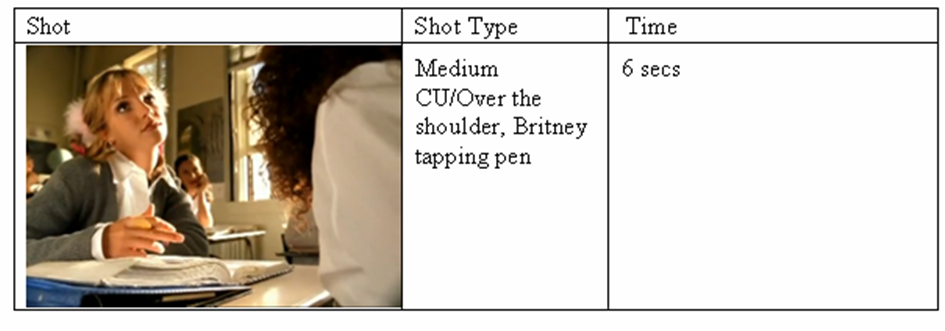
This is an example of the storyboarding we did for the Video Production task.
Also in my A2, research and planning i intend to do will be:
Research into other music videos, shot types commonly used, effects commonly utilised, effective locations, etc
Mise-en-scene: set or location design, plan carefully where video will be filmed. actors/singers chosen, costumes planned
Camera used, shot type used: steadycam, handheld, etc
Research into sound, which song would be most suitable for a music video
During the video production task, my knowledge of filming and editing technology increased considerably. My understanding of different shot types also improved, as I learned how to create them using a digital film camera. The video included shots such as tracking, medium close up, close up and wide shots, which when edited created a professional replica of the original video. To edit the video, we used video editing software called “Adobe Premiere Pro 2.0”, with which we used the clipping tools to create ‘invisible’ continuity editing. This software also made it relatively simple to sync the singer's mouth to the music, which is essential for the music video. This task reinforced this fact, and i have learned that it is incredibly important in video production to keep the timing with clips and sound accurate.
During the A2 year, i would like to make sure the lip sync on the main coursework task is more accurate, and i intend to develop my knowledge of shot types in order to create a professional looking music video. I would also like to create my video in a more diverse location.